This weekend in London, we saw what was one of many Tommy Robinson marches. The march drew tens of thousands to the streets, fueled by Islamophobia and ethnonationalist hate speech, to say the least. It was also announced by Robinson himself that the ring-wing “activists” should ‘prepare for the battle of Britain’.
Triggered by the growth of this movement, and a somewhat sense of despair, I reflected on a group of South Asian artists in 1947 Bombay who looked around at a world being redrawn by partition, by empire, by violence and decided to make art anyway.
To understand the Bombay Progressive Artists’ Group, you have to understand the moment they were born into and how it mirrors experiences for South Asian creatives in the UK’s current political climate.
It’s 1947. India has just won independence from British rule. But within weeks, Partition had torn the subcontinent in two. The formation of Pakistan resulted in religious rioting and the deaths of tens of thousands, with millions displaced by the new borders. The country is simultaneously celebrating freedom and haemorrhaging from the violence that came with it.
It is in this atmosphere of uncertainty about who India even is that chaos, grief and euphoria brew. This was the point at which six artists in Bombay decided to do something about it, and they called themselves the Progressive Artists’ Group (PAG).
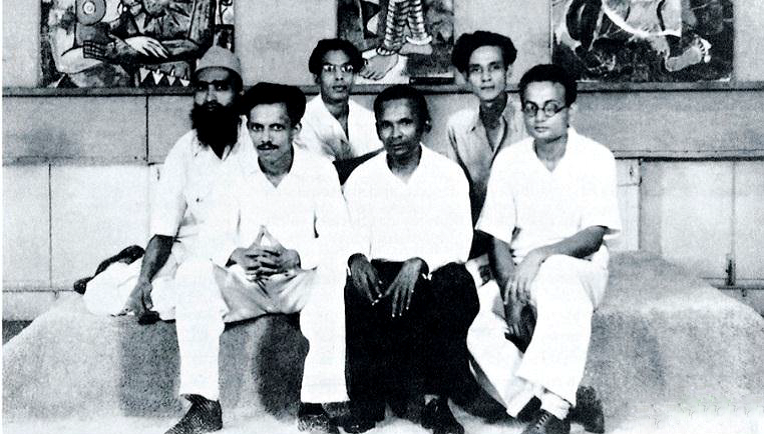
The PAG’s founding members, F.N. Souza, M.F. Husain, K.H. Ara, S.K. Bakre, H.A. Gade, and S.H. Raza, reflected India’s diverse range of social, economic, and linguistic backgrounds. A deliberate move to create a secular group by design, in a country that had been violently divided along religious lines.
The group formally came into being on December 15, 1947, following a meeting in Bombay where Souza, Raza, Ara and the critic Rashid Husain spoke about their disappointment with the lack of principles in the current exhibition judging process. They wanted to break the superficial selection system and bring greater transparency to create equal ground for rising artists to show their work.
Their anger wasn’t fuelled by aesthetics but by power. Power that lay in the hands of gatekeepers who decided what art mattered and whose work got to be seen.
Ostracised by the Indian art establishment, they staged their own exhibitions and events, aided financially by a group of refugees from war-torn Europe, in particular, the expressionist painter Walter Langhammer. Showing that their earliest support network was built on solidarity across displacement.
At the time, Indian art was dominated by two forces, and the PAG rejected both. The first was the Bengal School, a nationalist style that romanticised a pre-colonial India, nostalgic and backwards-looking. The second was the colonial academic tradition, a European style imposed by British art institutions, designed essentially to reflect empire back at itself.
These young artists had leftist leanings and were impressed by new art movements such as Cubism and Expressionism developing in post-war Europe. They rejected the historicism of the Bengal School and set out to develop a new modern visual language for independent India.
Up until the 1940s, the British-engineered Company School and nationalist art of Bengal ruled the art scene but with the expulsion of the British Raj in 1947, several groups sprang up during and after Partition that rejected existing artistic practices in favour of international art styles and movements.
The PAG’s answer was an amalgamation of European modernism tools such as Cubism, Expressionism, and Abstraction, and used them to tell South Asian stories, on South Asian terms. Not imitation. Synthesis.
Their stated intention was to “paint with absolute freedom for content and technique, almost anarchic, save that we are governed by one or two sound elemental and eternal laws of aesthetic order, plastic co-ordination and colour composition.”
The words ‘almost anarchic’ proved this wasn’t art for galleries, critics or the establishment but art as a declaration of sovereignty.
In its first manifesto, Souza wrote that they intended to bring about “a closer understanding and contact between different sections of the artist’s community and the people.” By the time their first major exhibition came about in 1949, Souza declared in a catalogue essay that the PAG would create “new art for a newly free India”. Freedom from rigid sentimental Indian styles as well as British cultural imposition. They wanted a new language that was more international in outlook and style.
And Souza put it even more bluntly about the institutions they were dismantling: “It is easier for a mob to carry out a lynching; and in this case, we found it necessary to lynch the kind of art inculcated by the JJ School of Art and exhibited in the Bombay Art Society.” Language rarely used of someone asking politely for change.
Each member developed a completely distinct style.
Souza combined elements from Goan folk art with Cubism.
Husain blended folk art influences and Cubist principles to depict Hindu mythological figures and narratives.
Raza, after experimenting with Expressionistic landscapes, moved into Geometric Abstraction.
Ara was known for his Impressionistic exploration of still lifes and human figures.
Gade developed what is now recognised as the first foray into Abstract Expressionism in post-Independence India.
Bakre, the only sculptor, established the shift in Indian sculpture from representational forms to abstraction.
The one artist I reflect on the most at this time is M.F. Hussain.
M.F. Husain dedicated his entire life to painting India. From the gods and myths to its people and history. He was coined as India’s Picasso. He painted in Cubist style with fluency and love for Indian culture.
And then, in the 2000s, Hindu nationalist groups targeted him for paintings depicting Hindu deities in the nude. Ironic given that the work sat entirely within India’s own ancient artistic tradition. His painting “Bharat Mata”, a nude personification of India, forced him into exile in 2006, with FIRs filed against him and persistent death threats following him wherever he went.
The courts ruled in his favour whilst his government stayed silent as several state governments fought to prosecute him for outraging religious sentiments.
In 2010, he accepted Qatari citizenship and surrendered his Indian passport. He died in London on June 9, 2011, at the age of 95, yearning to return home but unable to because of death threats against him.
A Muslim man who spent his life painting Hindu mythology with love and reverence was made stateless by nationalism. The very thing the PAG was built to resist, claimed its most beloved member.
The PAG didn’t have institutional support nor galleries willing to take them. They staged their own exhibitions when the establishment wouldn’t have them. They wrote their own manifesto when no one was handing them a platform and found patrons in unexpected places like European refugees or leftist organisations.
And they did all of this months after Partition, while the world was still shadowed by imperialism.
What struck me about these artists is that they didn’t wait for the Bombay Art Society to legitimise them. They created their own judging committees, their own exhibitions, their own critical frameworks. You don’t need permission to put your work in the world.
In today’s age, let your heritage and your present speak to each other. The PAG’s power came from refusing to choose between Indian tradition and global modernism. They held both. Your South Asian and your British identity are not in tension; they are the source material.
Make work that knows what it is. Husain painted India’s gods at a time when that was radical for a Muslim man to do. Souza painted distorted, sexualised religious figures in a deeply conservative environment. They were not making work to make people comfortable. They were making work that was true. Just as an artist should.
Community is the infrastructure. The PAG was six people who found each other, pooled what little they had, and changed the face of modern art. You don’t need to build an institution. You need to find your community.
The Bombay Progressive Artists’ Group lasted less than a decade. They held three exhibitions. They scattered across London, Paris, and Delhi. And yet nearly 80 years later, their work sells for millions, hangs in the world’s great museums, and still defines what South Asian modernism looks like.
As Tyeb Mehta, one of the artists close to the group, recalled: “There was no money, no patrons, only a desire to begin anew.”
And that’s the whole lesson I learned, one we should all learn.
As creatives, when the world screams rhetoric of who belongs and who doesn’t, you do not obey. You make the work. You find your people. You write the manifesto yourself.
They did it in 1947 Bombay. You can do it in 2026 London.
Sources:
MAP Academy (2024) Bombay Progressive Artists’ Group. MAP Academy. Available at: https://mapacademy.io/article/bombay-progressive-artists-group/ [Accessed 19 May 2026].
MAP Academy (2024) FN Souza. MAP Academy. Available at: https://mapacademy.io/article/fn-souza/ [Accessed 19 May 2026].
Prinseps (2025) Progressive Artists Group: Legacy of F.N. Souza, M.F. Husain, and Bhanu Athaiya. Prinseps. Available at: https://prinseps.com/research/progressive-artists-group-fn-souza-bhanu-athaiya-mf-husain-0820/ [Accessed 19 May 2026].
Google Arts & Culture (no date) The Bombay Progressives: Breaking New Ground at the Dawn of India’s Independence. Google Arts & Culture / Kerala Museum. Available at: https://artsandculture.google.com/story/the-bombay-progressives-breaking-new-ground-at-the-dawn-of-india’s-independence-kerala-museum/bwWR2KjgTwIrJQ [Accessed 19 May 2026].
Tate (no date) Bombay Progressive Artists’ Group. Tate. Available at: https://www.tate.org.uk/art/art-terms/b/bombay-progressive-artists-group [Accessed 19 May 2026].
Critical Collective (no date) Progressive Artists Group. Critical Collective. Available at: https://criticalcollective.in/ArtistGInner.aspx?Aid=182 [Accessed 19 May 2026].
Eikowa (2024) Progressive Artists Group: The Sextet of Artists That Incited an Artistic Revolution in Post-Independence India. Eikowa. Available at: https://www.eikowa.com/blogs/home-page-blogs-2/progressive-artists-group-pag-the-sextet-of-artists-that-incited-an-artistic-revolution-in-post-independence-indi [Accessed 19 May 2026].
Splainer (2024) Modern Art Makers: Bombay Progressive Artists’ Group. Splainer. Available at: https://splainer.in/sections/2024/Desert-Dreams/culture [Accessed 19 May 2026].