How do you tell a story as old as the Ramayana to an arena of thousands, and make it feel brand new?
Diwali Story: The Journey of Ram, a dance musical presented by Sanatan Events, did just that with movement, music and a cast that never stops giving.
Produced by Nitin Palan and written and directed by Sâmir Bhamra, the show took over the OVO Arena Wembley on 27th September. The room was packed and buzzing whilst waiting for the show to begin, and when the storytellers walked on, it fell silent. Luv (Dhrushil Vekaria), his sister Khushi (Aarushi Sharma), their father (Abhishek Gadhvi) and their grandmother (Bhavini Sheth) entered the stage and huddled together as the older two explained the origins of the epic to the young pair. Three generations together with one story being handed down. It was the right way in, giving a familiar memory of how most of us first met the Ramayana.

The stage opened. Snowy mountains rose behind the ensemble to mark the home of Lord Shiva and Parvati, and Raavan (Robin Ravi) appeared at prayer, muscles bristling, strength and arrogance in the same breath. The first dance landed, and the room leaned in.
That opening number was worth lingering on, because it set the vocabulary for the whole night. Indo contemporary and semi classical movement are blended rather than stacked, so neither feels like a guest in the other’s house. The hand gestures are technically precise, even from a distance, they read as language rather than ornament. The ensemble’s movement graceful and exact, yet fluid, never stiff, and it moved in tandem with the principals, so the dancers and the leads feel like one body telling the story. The coordination across so many performers is what heightened the experience. Precision at that scale is hard, and here it looks easy.
From there, contrast becomes the show’s choreographic engine. Raavan’s movement ferocious and percussive, built on weight and impact. The ensemble answered with something frenetic and full of energy, a perfect foil that never competes with him but never disappeared either. His strength landed harder because everything around him was moving faster. It is a smart piece of stage balance, and it kept the arena alive whenever he was on it.
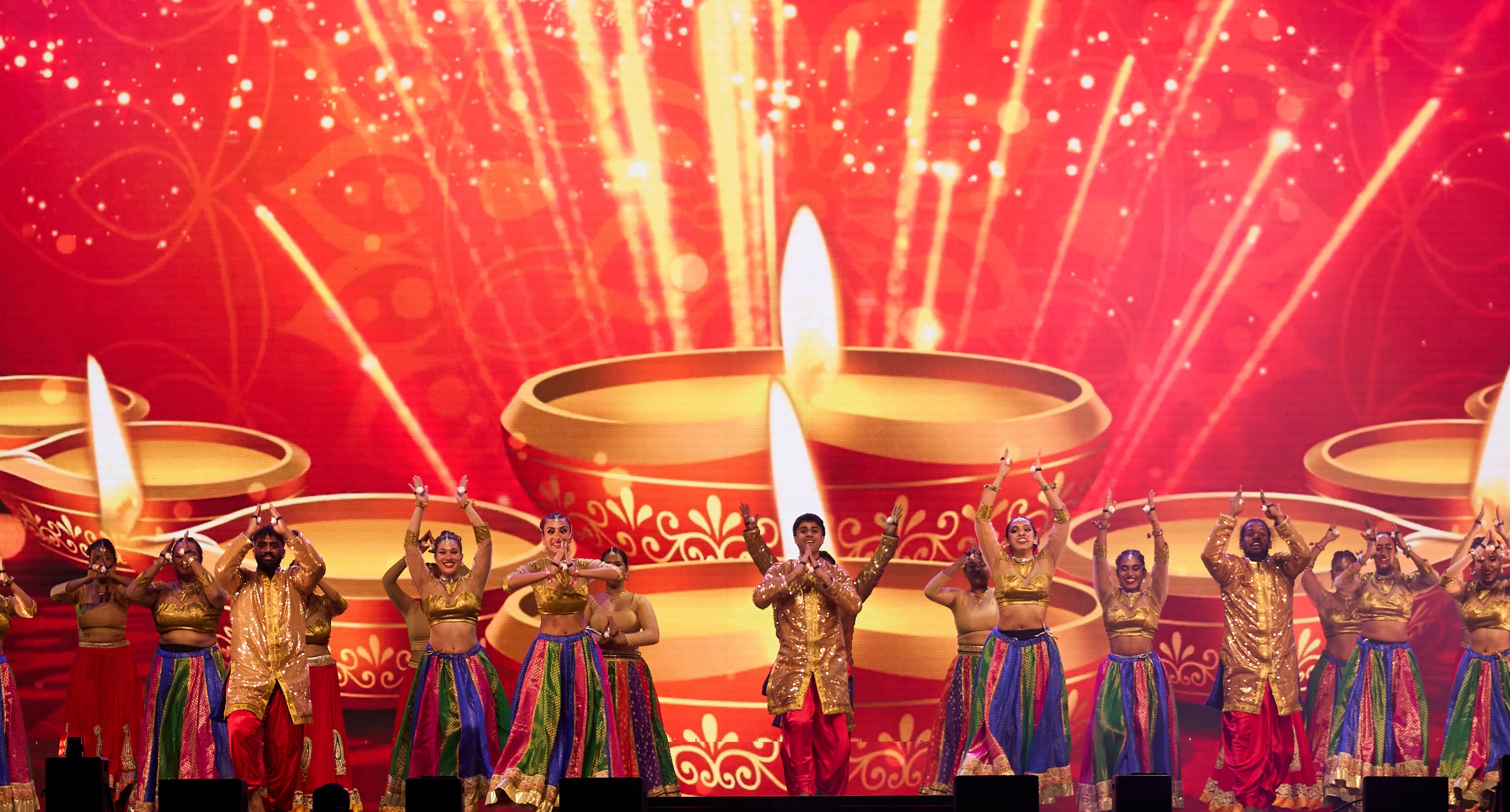
The ensemble then changed its body language to match whoever it was dancing beside. Around Shoorpanakha, Raavan’s demoness sister, they turned feral, with bold stomping movements that matched her menace. Vanshika Mitter’s playful wickedness as she tempts first Ram and then Lakshman is given real physical texture by the dancers around her. Alongside Pavan Maru’s athletic, bounding Hanuman, their movement spirals and leaps, mimicking the fearless warrior. As the stakes rise, a stronger jazz edge cuts in. The range from contemporary to semi classical to jazz is wide, and the dancers never looked unsure of where they are in it. Each shift in style marks a shift in the story, so the dance is never decoration. It is how the story gets told.
The movement stayed crisp from the first number to the last, and it is calibrated to balance the principals’ expressions, supporting them rather than upstaging them. That restraint is a skill in itself.
The ensemble is also the stage. They handled big props, trees, lotus petals and boulders, without breaking the flow of the choreography. They become Raavan’s army in the battle, the fighters who take on Hanuman as he burns down Lanka and even the horses that pull the chariot. Each of those transformations asks for a different physicality, and each is committed to completely. Between scenes, they changed from pre-stitched sarees to heavy lehengas to skin tight bodysuit and glided back on without a missed step or a fault in their footwork. Effortless is the only word for it.
The imagery is where the production showed off. Ravana’s wrath arrives dark and blood red, built from projections, flickering lights and great sweeps of red cloth. His ten heads come alive as dancers enter, each carrying the weight of one of his vices on their head, a striking image that turns dancers into symbols. Hanuman’s flight is a clever piece of layered staging, giving the illusion of him soaring through the blue sky. Ayodhya’s palace, Vashishtha’s gurukul and the Himalayan peaks are all brought to life through backdrop, costume and the dancers themselves.
Then comes the heart of the show...The battle between Raavan and Jatayu (Sidharth Banswal), choreographed by Rohan and Shruti Shah. Within minutes, you felt awe at Jatayu’s bravery as he fights to the death, sorrow at his fall, fury as Raavan carries Sita (Bhavithra Gananathan) away and then the ache of a devastated Ram (Kiran Kaanan) and Lakshman (Aarya Singh). Movement does what dialogue could not, and the room felt it together.

Credit goes to the acting too. Just eleven actors played the entire epic, several taking on up to three roles each. Rukmini Sircar as Manthara, Shabari and Mandodari, Chinmay Khandwala as Vashisht and Vibhishan, Prem as Bharat and Sugreev, Charlotte Barnes as Kaikeyi and Vali, and Rajeev Mandal as Sambarasura and Vishwamitra. Rahul Ranade’s original score, searing and soul stirring, ties every moment together, and the songs, a blend of modern and traditional, are delivered with aplomb, serenity and a little sauciness.
And we can't forget the dance ensemble, who brought the story to new heights: Nitya Chikodi, Divya Nebel, Heer Mohan, Siddhi Subramanian, Kavit Haria, Diya Lakhani, Janki Patel, Vivek Mekala, Kirti Dash, Aryan Shah, Ananya Jain, Mukta Barve, Ankur Rajput, Anshika Desai, Priya Umarjan and Jothi Valan. They twirled in tandem, leapt across the stage and danced their hearts out all night. Their grace was unbound, and their talent unmistakable.
The finale brought Ram, Sita and Lakshman home to Ayodhya, and the arena thundered. Fireworks lit a starlit sky, a fitting image of Diwali, the festival of lights.
A great homage to the Ramayana, and a credit to the collaboration of production, cast and crew. Sumptuous, uplifting and full of heart.