
It’s 2026. Reform UK is marching into power and the far right is emboldened. Hatred, racism and Islamophobia are organised, public, and confident.
So popular Black and Brown solidarity is no longer optional. It is urgent. Not as a slogan or aesthetic of representation, but as a survival strategy.
Too many public figures who look like us – Shabana Mahmood, Priti Patel, David Lammy, Kwasi Kwarteng, Sajid Javid and more – have shown how easily representation can be weaponised against the communities it claims to serve.
Politicians who trade our communities for power, using their identity as a shield while upholding racist structures, are often more dangerous than those openly committed to division.

Foreign Secretary David Lammy with Prime Minister Netanyahu in Jerusalem, Israel on 14th July 2024
And divide-and-rule has always been the Empire’s favourite weapon. It convinces us that our neighbour is our competitor, that our liberation is a zero-sum game. It thrives on manufacturing wedge issues, pitting us against each other for scraps while the machinery of racial capitalism marches on.
Too often, our communities have fallen into that trap. Anti-Blackness, anti-Asian sentiment, Islamophobia and inter-community hostility continue to fracture us, whether through racist assaults in Peckham or influencers calling for boycotts of South Asian shops. When we turn on one another, the only forces strengthened are white supremacy and the far right.
But look at the numbers: together, Black and Brown people comprise 13.3% of the UK’s population, which is 72% of Britain’s non-white population.
That demographic truth is not just a statistic; it’s a responsibility. We are not marginal to this country’s future, we are central to it. But without collective action, those numbers mean very little.
Real solidarity cannot stop at the edges of census categories. Many of our communities are here because of the Empire, and our struggles were never separate to begin with. Our liberation is knotted up with our Arab siblings fighting surveillance, state suspicion and genocidal regimes, with East and Southeast Asian communities resisting a resurgence of racialised scapegoating, and with anyone who has been told they do not belong.
Whether through Prevent ‘counter terrorism’, hostile environment policies, immigration raids, anti-protest laws, or the disproportionate policing of Black communities, the state already treats many of us as populations to be monitored, managed, and contained rather than protected.

So we must move alongside those whose liberation is tied up with our own.
Music, fashion, and cultural life in Britain have always blurred, blended, and cross-pollinated across the false borders of “Black” and “Asian.” The shared cultural worlds we’ve built – from sound systems to jungle, garage, grime and bhangra – were born in overlapping neighbourhoods, on shared pirate radio frequencies and in clubs where Black and Asian youth shaped one another’s style, politics and sound. Our unity isn’t theoretical – it’s lived, created and danced into being.
Artists, DJs and club spaces continue that tradition of cultural exchange, from Mist and Steel Banglez’ ‘Apnas, Kalas, Goras’ to AfroDesi, DialledIn, Yung Singh, Nooriyah and Manara blending sounds across communities. Even the celebrations that erupted across London after Arsenal’s Premier League win were a reminder that joy, identity and belonging in Britain are already deeply shared across Black and Brown communities.

Our history is proof of what’s possible when we refuse those boundaries. In India, the Dalit Panthers took up the Black Panthers’ call not out of mimicry but out of recognition: that anti-Blackness, casteism, and state violence share a political root. In West London, Southall Black Sisters built radical cross-community feminist coalitions grounded in shared struggle rather than shared ethnicity.
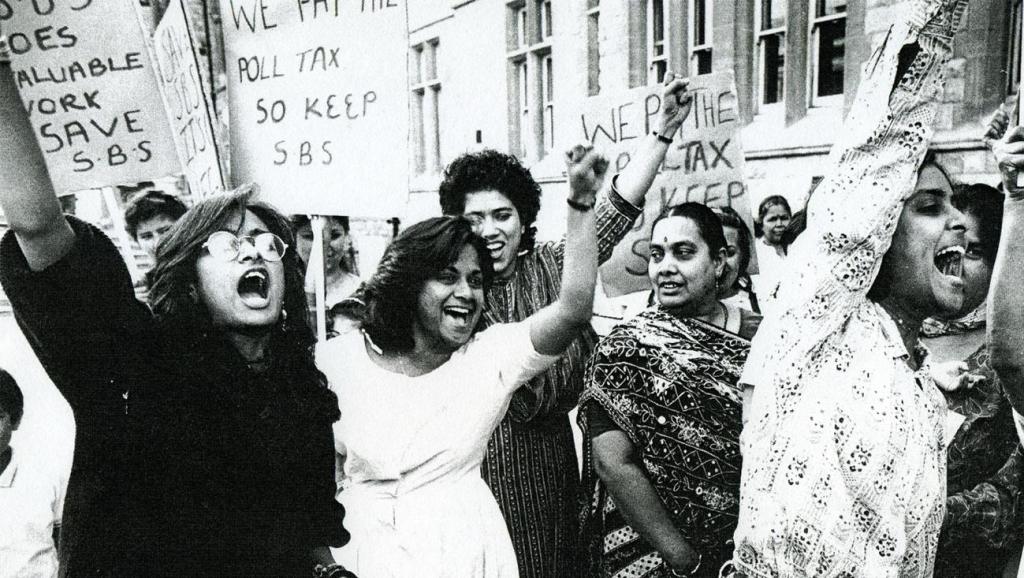
Southall Black Sisters (SBS)
The Asian Youth Movements of the 1970s and 80s understood this too. They used “Black” not simply as an ethnic label but as a political identity rooted in shared resistance to racism, fascism, policing, and empire. After the killing of anti-racist teacher Blair Peach during protests against the National Front in 1979, Black and Asian communities stood together against the National Front and police violence, understanding that fascism never arrives neatly targeted at only one of us.
At the Grunwick strike in 1976, predominantly South Asian women workers stood alongside Black and white trade unionists in a shared struggle against exploitation, showing how solidarity could be built not despite difference, but through it. From Rock Against Racism gigs to Anti-Nazi League marches, culture and resistance in Britain have long been built collaboratively across Black and Brown communities.
Recent movements for Palestinian liberation have also shown how Black, Brown and migrant communities continue to organise together against surveillance, militarism and racial state violence.

Southall Youth Movement
What this moment needs is a renewal of that tradition: an unapologetic, popular, bottom-up solidarity that cannot be bought or co-opted, and that rejects capitalist fantasies of ‘model minority’ success. Forget the Black Pound. Forget the Asian entrepreneur myth.
Capitalism does not become liberatory because more diverse faces sit at the top of it. Racial capitalism can accommodate Black and Brown elites perfectly well, so long as exploitation continues underneath them.
Our solidarity must be about collective safety, political resistance, and the possibility of a future where we are not simply surviving but shaping the terms of our lives. That means confronting anti-Blackness, Islamophobia, casteism and anti-Asian prejudice within our own communities and building forms of solidarity rooted in our temples, churches, mosques, high streets and community centres.
The far right is bold. The state is tightening its grip. But the ground is fertile. Our only viable response is to build bridges within and across our communities and organise with clarity and conviction.
When our communities move together – truly together, not perfectly, but with purpose – the political landscape doesn’t just shift, it shakes.


